
From Spiders to the Moon: Crest Robotics’ Bold Vision for Sustainable Space Construction
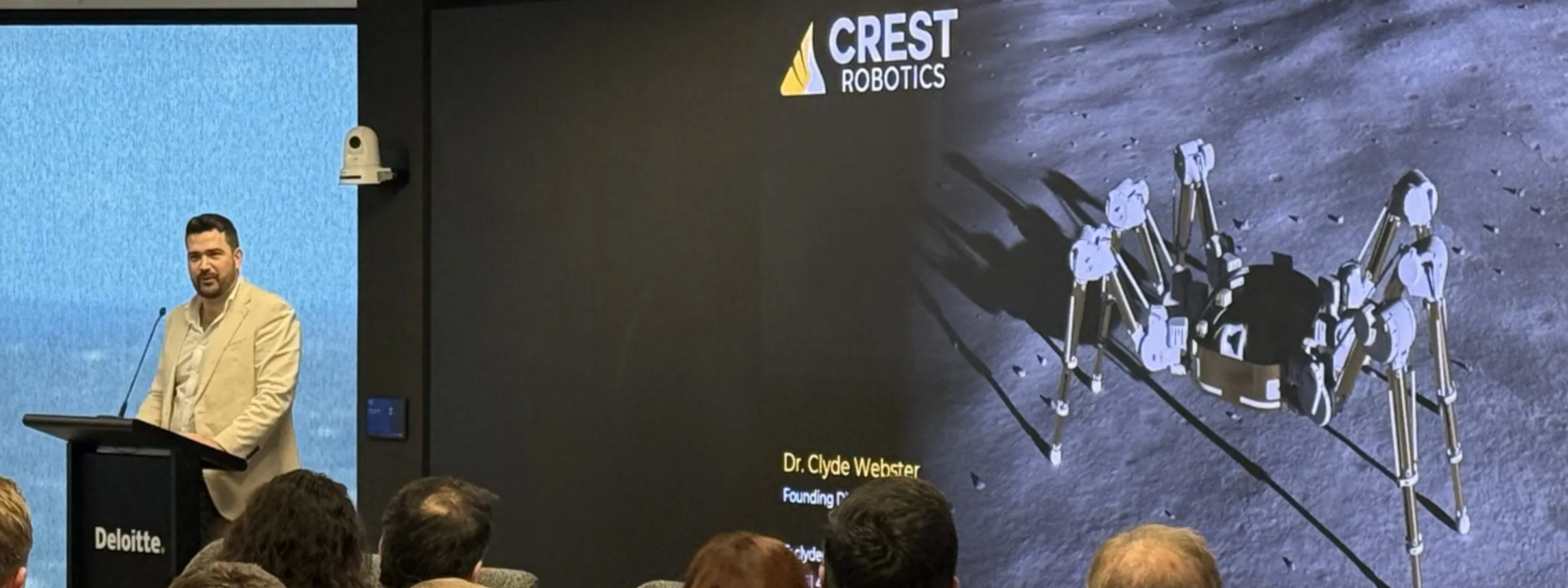
At last week’s New Horizons Summit in Sydney, Crest Robotics took to the stage with what was the most striking prototype of the conference: a giant robotic spider. Addressing the “elephant-sized spider in the room,” Founding Director, Dr Clyde Webster (pictured), initially made light of what is a serious piece of engineering and sets a bold vision for Australia’s role in the next phase of lunar exploration.
Crest Robotics is part of a new wave of companies looking to apply Australian ingenuity to off-world construction. Backed by a half-million-dollar grant under the NSW Government’s ‘Spark Space+ program’, the team is working on robotic systems capable of building sustainable shelters on the Moon. Their work combines lunar dust mitigation, robotic construction methods, and automation techniques first imagined for Earth, but now finding a natural application in the extreme environment of space.
The Dust Problem
If humans are to establish a permanent presence on the Moon, the first challenge is not water or air, but dust. NASA has long identified lunar dust mitigation as a top priority. The fine, electrostatically charged particles can clog machinery, damage seals, and endanger astronauts. Crest Robotics’ engineers reached the same conclusion: before we can dream of habitats, starships, or lunar mining, we need infrastructure that manages dust and protects equipment.
Their solution is elegantly simple: start small. Instead of landing massive vehicles straight onto the regolith, smaller autonomous machines can first prepare the ground. By collecting loose dust and compressing it into bags, machinery can create structural layers, build roads, and form protective shelters. The approach borrows from a century-old technique known as ‘earth bagging’—traditionally used on Earth to build durable, low-cost housing. Translated to the Moon, it becomes “moon bagging,” a sustainable way to turn dust into infrastructure.