
How US Navy's New Air-to-Air Missile Can Thwart China Threat
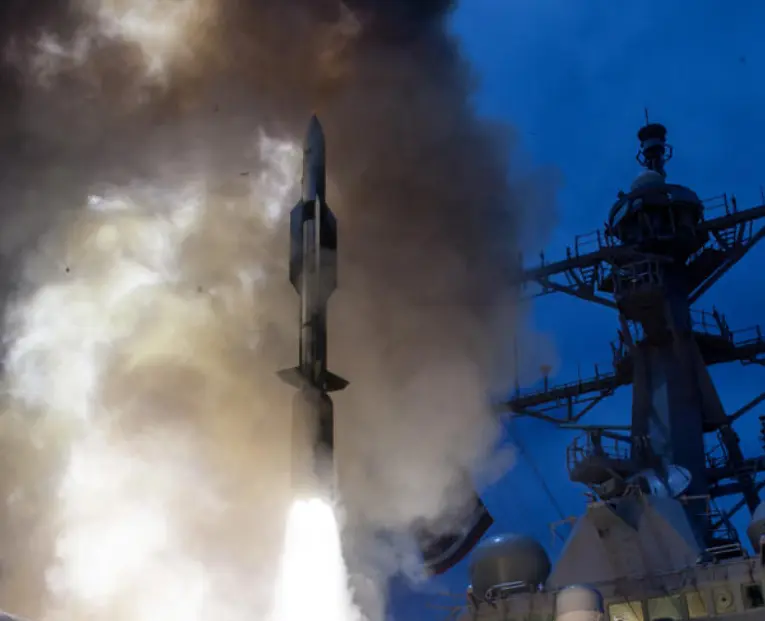
The United States Navy has recently put a new air-to-air missile into service as part of an effort to enhance its ability to protect valuable aircraft carriers from China's evolving long-range threats within the Western Pacific region.
As the U.S. military assembled forces with allies and partners for maritime exercise Rim of the Pacific (RIMPAC) in Hawaii, a U.S. Navy F/A-18E fighter jet was spotted carrying two unusual and huge missiles at Joint Base Pearl Harbor-Hickam on July 2, The Aviationist reported.
F/A-18E and its two-seat variant F/A-18F, dubbed Super Hornet, are the primary multirole fighter jets of the Navy's aircraft carriers. Besides striking targets on land and at sea, their main task would be acting as the first line of defense to protect the mother ships.
In a wide maritime operational environment like the Pacific Ocean, Chinese long-range threats such as cruise missiles, bombers, and drones can be used to form a "keep-out zone," to deter or deny the U.S. Navy carrier strike groups approaching China's waters.
Brian Hart, a fellow with the China Power Project at the Center for Strategic and International Studies, told Newsweek via email that China has been pursuing the development of anti-access/area denial capabilities for decades.